





In the search for longer-lasting therapies for retinal vascular disease, investigators are exploring therapies that combine VEGF inhibition with additional biologic targets. One of them is tiespectus (MK-8748), an investigational bispecific being developed by Merck, that combines VEGF inhibition with direct activation of the Tie2 pathway.
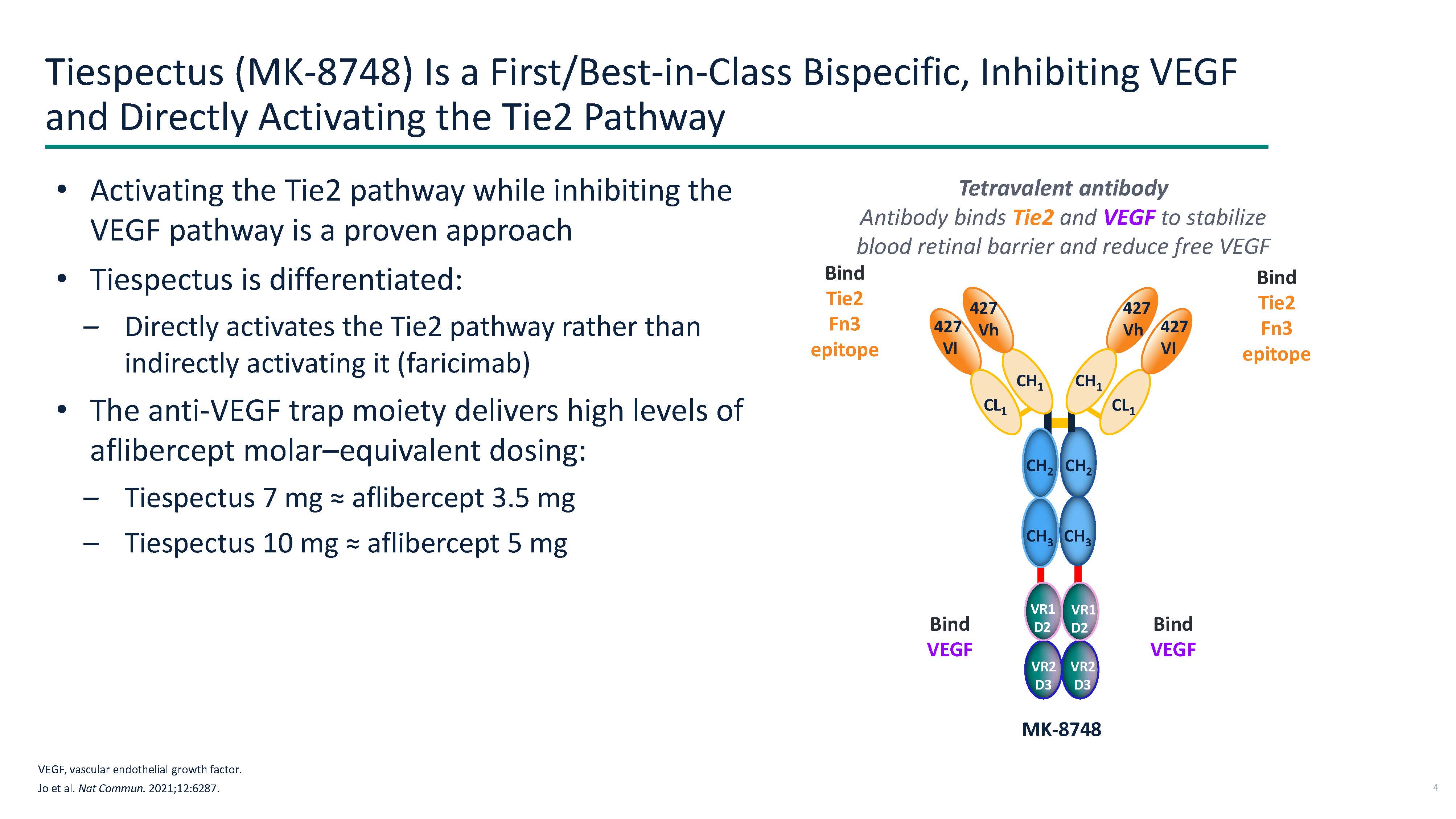
Figure 1. Tiespectus (MK-8748; EyeBio/Merck) is an investigational bispecific designed to inhibit VEGF while directly activating the Tie2 pathway.
At the American Society of Retina Specialists (ASRS) annual meeting in Montreal, Baruch D. Kuppermann, MD, PhD, director of the Gavin Herbert Eye Institute at the University of California, Irvine, described the investigational therapy as a different approach to dual-pathway inhibition (Figure 1). "Tiespectus is a first-/best-in-class bispecific agent inhibiting VEGF and directly activating the Tie2 pathway," he said. "Faricimab does this in a differentiated way. This is direct activation, as opposed to indirect activation.”
The phase 1/2a RIOJA trial is evaluating tiespectus in patients with neovascular age-related macular degeneration (nAMD), diabetic macular edema (DME), and branch retinal vein occlusion (BRVO). At ASRS, Dr. Kuppermann presented findings from the BRVO cohort, an open-label dose-escalation study that enrolled 12 treatment-naïve patients with macular edema secondary to BRVO. Four ascending-dose cohorts (1 mg, 4 mg, 7 mg, and 10 mg) each included 3 patients who received intravitreal injections every 4 weeks for a total of 3 doses. Dose escalation proceeded only after the preceding cohort completed 1 week of follow-up without safety concerns.
Dr. Kuppermann reported that all dose levels were well tolerated. "There were no drug-related safety concerns here," he said. "All patients got the full 3 doses." No rescue therapy was required, and investigators reported no evidence of intraocular inflammation or retinal vasculitis during the 12-week primary study period, he said.

Figure 2. In the phase 1/2a RIOJA study, mean best-corrected visual acuity improved across all 4 dose cohorts through 12 weeks, with a mean gain of 16.7 ETDRS letters overall.
Although the study was designed primarily to evaluate safety, improvements in vision and retinal anatomy were observed across dose cohorts. Mean best-corrected visual acuity (BCVA) improved by 16.7 ETDRS letters at week 12 (Figure 2), whereas mean central subfield thickness (CST) decreased by 157.8 µm (Figure 3). Dr. Kuppermann noted that improvements were evident within the first week of treatment. "You can see the response as early as 1 week," he said. “Significant structural and functional responses observed at week 1 were sustained through week 12.” He also noted evidence of increasing activity across higher doses.
Durability assessment is continuing for the BRVO cohort of the study, said Dr. Kuppermann. However, Merck is moving forward in other therapeutic areas. Earlier this year, the company initiated 2 pivotal phase 2b/3 trials of tiespectus in nAMD, MALBEC and TORRONTES. Both studies are evaluating intravitreal tiespectus vs aflibercept 2 mg (Eylea; Regeneron) and are estimated to be completed in mid-2028. RP

Figure 3. Mean central subfield thickness decreased across all dose cohorts through 12 weeks, with an overall mean reduction of 157.8 µm.