




Vitreoretinal care has changed substantially over the past 2 decades, with procedure volume rising as Medicare reimbursement declined. According to an analysis of Medicare data from 2000 through 2021, presented at the 59th annual meeting of the Retina Society in Los Angeles, the volume of vitreoretinal procedures increased sixfold during that period, while inflation-adjusted reimbursement declined by an average of 32%.
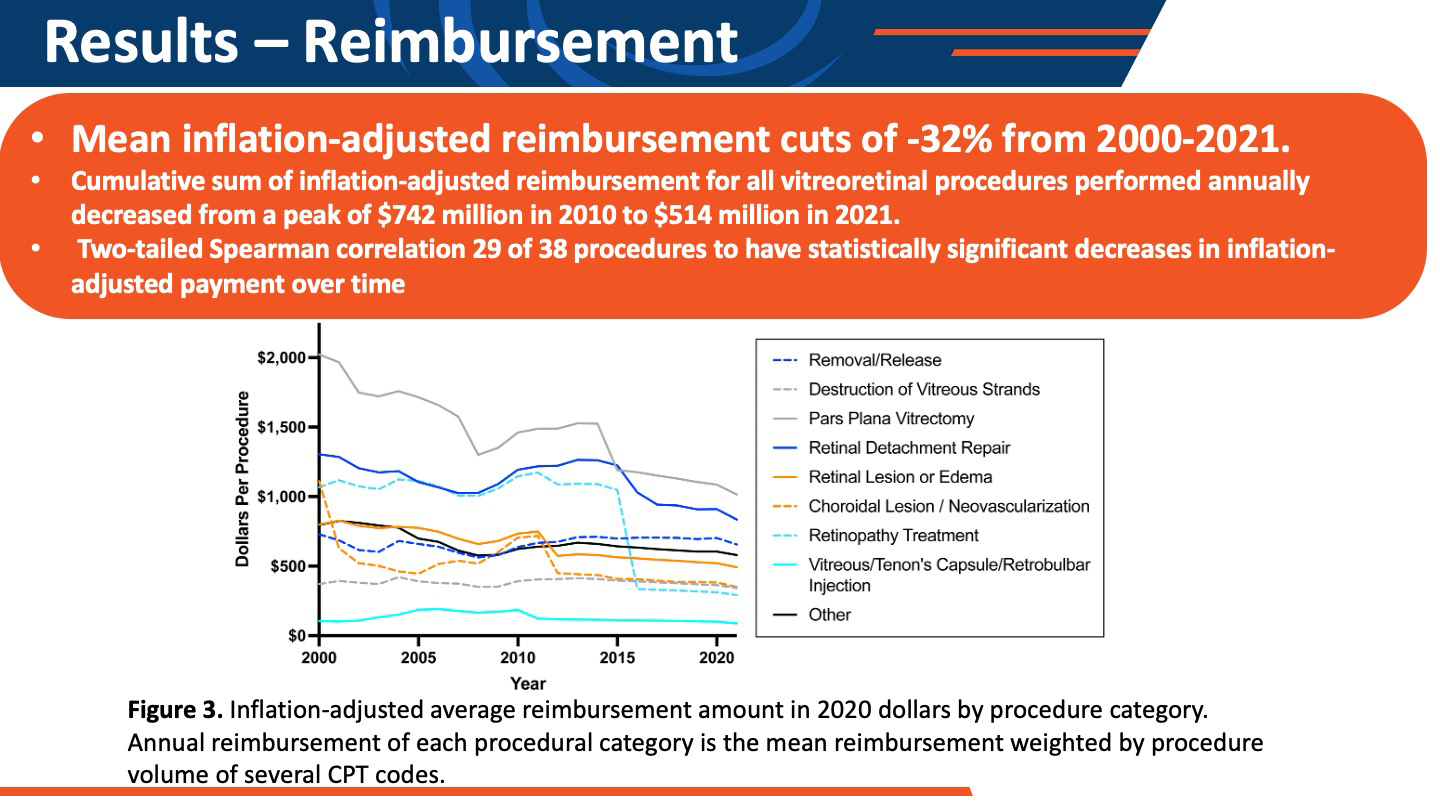
Figure 1. On average, inflation-adjusted reimbursement dropped by 32% over 21 years. Some services experienced even steeper cuts: Intravitreal injection had a reimbursement cut of 66%, and panretinal photocoagulation had a cut of over 70%.
In the study, Ron Adelman, MD, MPH, MBA, and Eric Li, MD, examined Medicare fee-for-service data for 38 vitreoretinal procedures, with reimbursement adjusted to 2020 dollars using Consumer Price Index data. Dr. Adelman noted that total procedure volume increased from 527,050 in 2000 to 3,758,290 in 2021. Much of that increase was driven by intravitreal injections, which rose more than 1,100-fold, from 2,922 in 2000 to 3,444,500 in 2021. Despite the overall increase, 20 of the 38 procedures analyzed showed statistically significant decreases in volume.
Treatment patterns also shifted over the study period. Scleral buckling for retinal detachment declined significantly. Pars plana vitrectomy, meanwhile, increased from 71,039 to 95,429 procedures.
Reimbursement moved in the opposite direction for most procedures. Dr. Adelman reported statistically significant declines in inflation-adjusted payment for 29 of the 38 procedures, and no procedure had a statistically significant increase. The largest reductions included panretinal photocoagulation, which declined 73%; cryotherapy for retinopathy, 69%; intravitreal injection, 66%; and cryotherapy for retinal detachment, 65%. The cumulative inflation-adjusted reimbursement for vitreoretinal procedures performed annually also declined from a peak of $742 million in 2010 to $514 million in 2021.
Overall, mean inflation-adjusted reimbursement declined 32% during the study period (Figure 1). “That’s a significant impact on practices,” Dr. Adelman said, noting that the effect can be magnified once operating expenses are considered. Using a practice with 50% overhead as an example, he explained that only 50 cents of each reimbursement dollar remains after expenses. A 32-cent reduction in reimbursement would therefore represent a 64% reduction in the amount left for the physician or practice owners.
Dr. Adelman also raised concerns about access to surgical retinal care, noting, “We all know that access to the operating room is difficult on the weekends.” He pointed to a separate analysis of pars plana vitrectomy for rhegmatogenous retinal detachment at a large academic center.1 That study calculated an average cost of $6,247.17 and reimbursement of $5,442.91, producing a net loss of $804.26 per procedure. “That’s not sustainable,” he said. RP

References
1. Hwang MW, Bommakanti N, Young BK, Besirli CG. Time-driven activity-based cost analysis of pars plana vitrectomy in rhegmatogenous retinal detachment at a large academic center. J Vitreoretin Dis. 2024;9(1):26-30. doi:10.1177/24741264241288655